Thousands of Saskatoon homes have basement suites that aren't legal — no separate entrance, no permits, not up to code. Nasik Sami's Stonebridge home was one of them. He had an existing suite downstairs, but without a separate entrance and proper permits, it wasn't code-compliant, wasn't insurable, and didn't qualify for the Saskatchewan Secondary Suite Incentive. He decided to do it right. Two and a half months later, he had a fully legal 1-bedroom, 1-bathroom suite — and $35,000 back from the SSI Grant. Here's every step of that conversion.
Have a non-conforming suite? Our legal basement suite contractor handles the full conversion — engineering, permits, construction, and SSI Grant paperwork. Get a free quote or try our SSI Grant Calculator to see how much you could get back.
Project Overview
| Location | Stonebridge, Saskatoon |
| Project Type | Non-Conforming to Legal Suite Conversion |
| Suite | 1-Bedroom, 1-Bathroom Legal Secondary Suite |
| Timeline | ~2.5 months (permits to occupancy) |
| Cost Range | $65,000 - $90,000 |
| SSI Grant Recovered | $35,000 |
| Net Cost After Grant | $30,000 - $55,000 |
| Key Work | Foundation cut, separate entrance, staircase, full interior buildout |
What is a Non-Conforming Suite?
A non-conforming suite is a basement living space that exists but doesn't meet the building code requirements to be classified as a legal secondary suite. Common issues include:
- No separate entrance — the most common disqualifier in Saskatoon
- No building permits — the suite was built without City approval
- Inadequate egress — windows too small for emergency escape
- No fire separation — missing fire-rated drywall between floors
- Electrical or plumbing not to code — never inspected by TSASK or a licensed plumber
Nasik's Stonebridge suite had the biggest issue: no separate entrance. Saskatchewan's building code requires a legal secondary suite to have its own dedicated entrance that doesn't pass through the main dwelling. Without it, the suite can't be legally rented, can't be insured as a rental, and doesn't qualify for the SSI Grant.
The risks of operating a non-conforming suite are serious — insurance denial, personal liability if a tenant is injured, and potential fines. For the full breakdown, read our guide on legal vs illegal basement suites in Saskatoon.
Phase 1: Engineering & Permits
Converting a non-conforming suite isn't a weekend DIY project. Before any construction could start, we needed two things: a civil engineer and building permits.
A key tailwind for this project: Saskatoon's Zoning Bylaw 9990, which took effect January 3, 2025, made secondary suites a permitted use in R1 and R2 residential zones. Under the old bylaw, many zones required discretionary approval. Stonebridge is zoned R1 — so Nasik's conversion was permitted by right, with no rezoning or special approval needed.
Our civil engineer designed the foundation cut and new separate entrance. Cutting into an existing foundation is structural work — the engineer calculates load paths, specifies reinforcement (steel lintels, rebar), and produces stamped drawings that the City requires for the permit application.
We pulled two permits from the City of Saskatoon:
- Building permit for the secondary suite — covers the interior conversion, fire separation, egress, plumbing, and electrical
- Building permit for the separate entrance — covers the foundation cut, new exterior landing, staircase, and drainage
As of January 2026, the City's Legalizing Existing Suites (LES) permit fee is $2,250 (up from $1,750 in 2025). Combined with engineering fees ($2,000-$4,000 for stamped drawings), expect $3,000-$5,000 total for the permit and engineering phase.
Why You Need an Engineer for Foundation Cuts
Cutting into a foundation wall compromises the structural integrity of your home. A civil engineer must assess the existing foundation, design the opening with proper headers and supports, and provide stamped drawings. Never cut a foundation without engineering approval — it can cause settling, cracking, or catastrophic failure. This isn't optional; the City of Saskatoon won't issue the permit without stamped engineering drawings.
Phase 2: Foundation Cut & Separate Entrance
This was the biggest and most expensive phase of the project. The crew excavated outside the foundation wall, cut the opening for the new door, installed a steel lintel header, and built the exterior landing with proper drainage away from the house.
The foundation cut alone is typically $8,000-$15,000 depending on soil conditions, depth, and whether the landing needs a retaining wall. It's the single most expensive line item in a non-conforming to legal conversion — but it's the one thing that makes everything else possible.
Phase 3: Staircase, Framing & Rough-In
With the foundation cut complete and the exterior entrance in place, the interior work began. The new interior staircase connects the suite to the separate entrance. Walls were framed for the bedroom, bathroom, kitchen, and living areas. Electrical, plumbing, and HVAC rough-ins were completed and inspected before drywall.
Inspection Checkpoints
A legal suite conversion requires multiple inspections throughout the build: framing inspection, electrical rough-in (TSASK), plumbing rough-in, insulation, and final inspection for occupancy. Each inspection must pass before the next phase of work can begin. Skipping inspections means the suite won't get an occupancy permit — and won't qualify for the SSI Grant.
Phase 4: The Finished Legal Suite
After 2.5 months of construction, Nasik's Stonebridge home went from a non-conforming basement to a fully permitted, inspected, and legal secondary suite. Every room was finished to a modern standard — the kind of suite that rents fast and commands top-of-market rates.
Before & After: Framing to Finished Kitchen
Drag the slider to see the transformation — from interior framing and electrical rough-in to a fully finished modern kitchen.
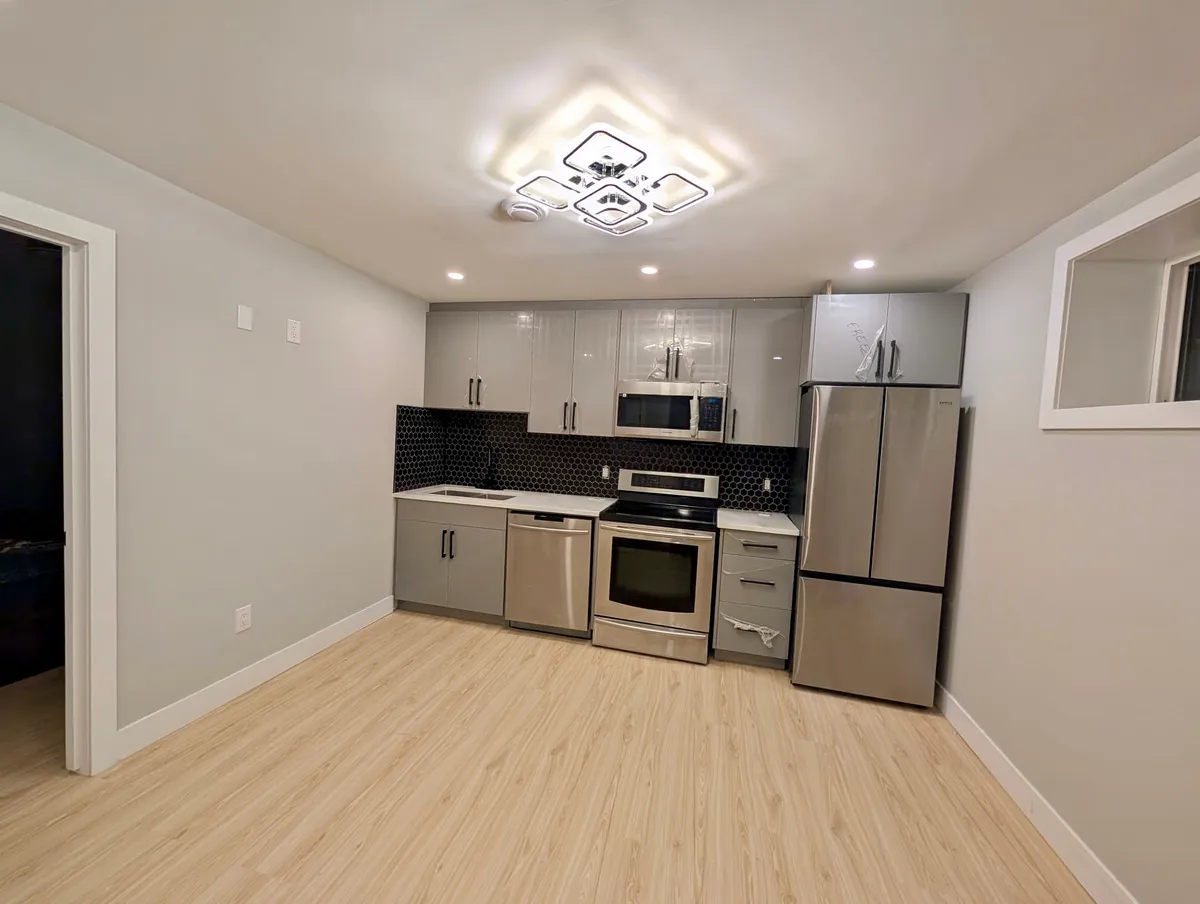
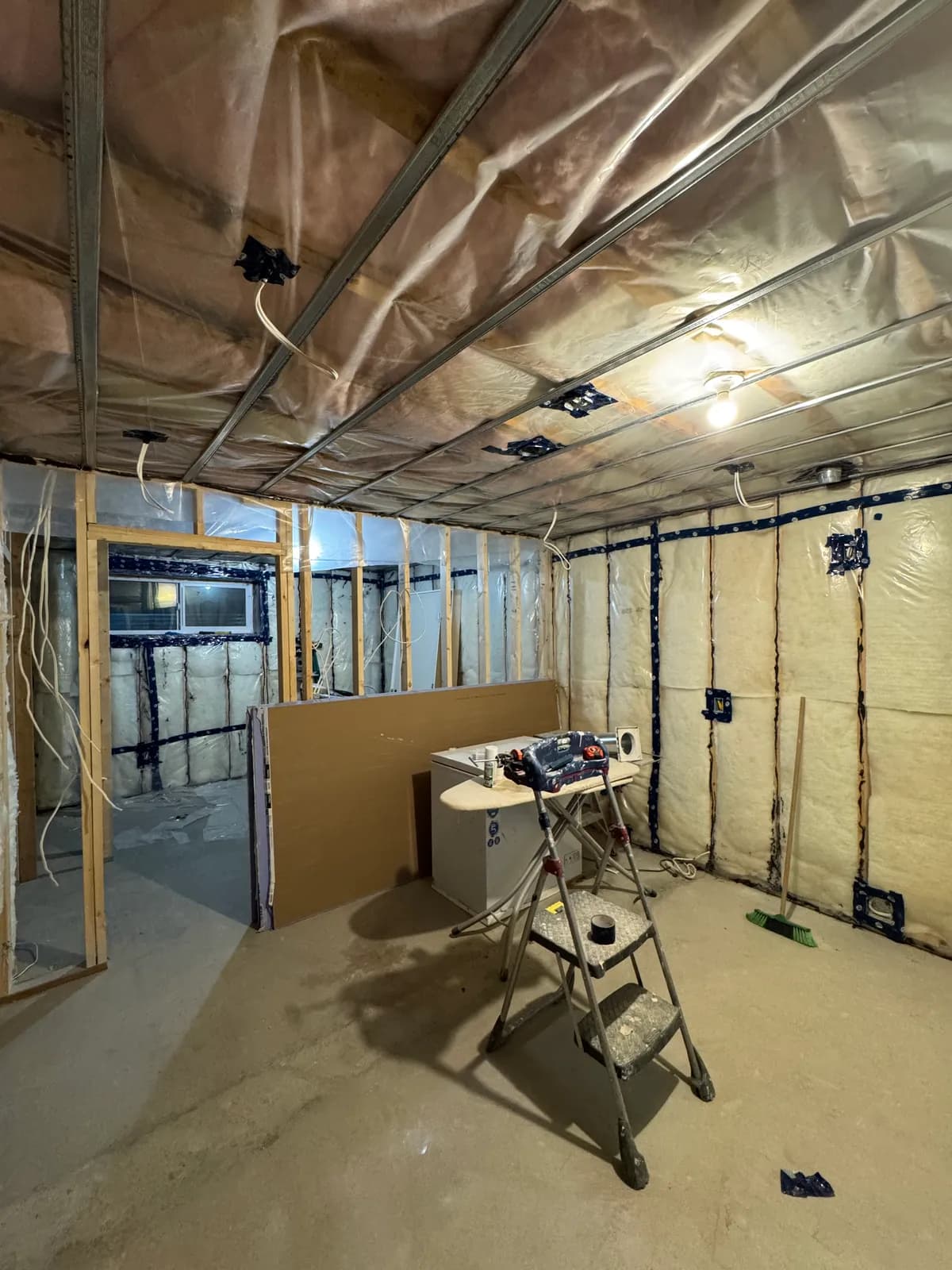
Kitchen
Stainless steel appliances, black tile backsplash, gray cabinetry with modern hardware, and light wood laminate flooring. The kitchen includes a full-size fridge, stove, dishwasher, and microwave — everything a tenant needs.
Bathroom
Modern gray vanity with black tile shower surround, white bathtub with shower enclosure, and marble-look tile flooring. The powder room features white subway tile with a clean, minimal aesthetic.
Bedroom
Spacious bedroom with light wood laminate flooring, modern ceiling light fixture, and an egress-compliant window for emergency escape — a requirement for legal suite status.
Interior Staircase & Entrance
The new interior staircase connects the suite to the separate exterior entrance — the element that transforms this from a non-conforming space into a legal secondary suite.
The Numbers: Cost Breakdown & SSI Grant
| Category | Approximate Range |
|---|---|
| Foundation cut & separate entrance | $10,000 - $15,000 |
| Civil engineering & permits | $3,000 - $5,000 |
| Framing & staircase | $8,000 - $12,000 |
| Electrical & plumbing | $8,000 - $12,000 |
| Drywall, paint & flooring | $6,000 - $10,000 |
| Kitchen (cabinets, counters, appliances) | $8,000 - $12,000 |
| Bathroom (tile, fixtures, vanity) | $5,000 - $8,000 |
| HVAC & fire separation | $4,000 - $6,000 |
| Total Project Cost | $65,000 - $90,000 |
| SSI Grant Recovered | - $35,000 |
| Net Investment | $30,000 - $55,000 |
With a 1-bedroom suite in Stonebridge renting for $850-$1,100/month (consistent with CMHC 2025 Saskatchewan rental data), Nasik's net investment of $30,000-$55,000 pays back in 3-5 years through rental income alone. After payback, it's pure cash flow. Plus, a legal suite increases the property's resale value by an estimated $40,000-$60,000.
Saskatoon's rental market supports this investment: CMHC reports a 3.5% vacancy rate in the Saskatoon CMA, and the city's rent-to-income ratio sits around 18% — one of the lowest in Canada, meaning strong tenant demand with low default risk.
$35,000 SSI Grant — The Full Amount
Nasik received the maximum SSI Grant of $35,000 — that's 35% of eligible costs, capped at $35K. The grant covers construction costs for creating a NEW legal secondary suite. Converting a non-conforming suite to a legal one does qualify because the previous space was never permitted. The SSI program has been extended to December 31, 2027 (construction completion deadline). Saskatchewan is the only prairie province offering a grant this size — Alberta and Manitoba have no equivalent program. Use our SSI Grant Calculator to estimate your rebate.
What's Included in a Non-Conforming to Legal Conversion?
Frequently Asked Questions
How much does it cost to convert a non-conforming suite to legal in Saskatoon?
A full non-conforming to legal conversion in Saskatoon typically costs $65,000-$90,000. The biggest cost drivers are the foundation cut for the separate entrance ($10K-$15K), engineering and permits ($3K-$5K), and the full interior buildout (framing, electrical, plumbing, finishing). With the SSI Grant covering up to $35,000, your net cost can be as low as $30,000-$55,000.
Do I need an engineer to legalize my basement suite?
Yes, if you're cutting into the foundation for a separate entrance. A civil engineer must design the opening, specify structural reinforcement, and provide stamped drawings. The City of Saskatoon requires stamped engineering drawings before issuing a building permit for foundation work. Even if you're not cutting the foundation, an engineer may be needed to certify that the existing structure meets code.
What is the SSI Grant and can I use it for a suite conversion?
The Secondary Suite Incentive (SSI) Grant is a Saskatchewan government program that reimburses homeowners 35% of eligible construction costs, up to $35,000, for creating a new legal secondary suite. Converting a non-conforming suite to a legal one does qualify because the previous space was never permitted. Nasik received the full $35,000. The program was extended in February 2026 with a construction completion deadline of December 31, 2027. Saskatchewan is the only prairie province with a grant this size — Alberta and Manitoba have no equivalent. Check our complete SSI Grant guide for eligibility details.
How long does it take to convert a non-conforming suite?
Expect 2-4 months from permit approval to occupancy. Nasik's project took about 2.5 months. The timeline depends on the scope of foundation work, complexity of the build, and inspection scheduling. Engineering and permit approvals can add 2-4 weeks before construction begins.
Do I need a separate entrance for a legal suite in Saskatoon?
Yes. Saskatchewan's building code requires a legal secondary suite to have a dedicated entrance that doesn't pass through the principal dwelling. This is the most common reason existing suites aren't legal — and it's the most expensive thing to add (foundation cut required). Without it, the suite cannot receive an occupancy permit.
What building code requirements must a legal suite meet?
A legal suite in Saskatoon must have: a separate entrance, bedroom with egress window, fire-rated ceiling separation (5/8" Type X drywall), smoke and CO detectors, separate HVAC zone, full kitchen, full bathroom, and minimum ceiling height of 6'5" (1.95m) for at least 75% of the floor area. All work must be permitted and pass City inspections.
Is it worth legalizing my non-conforming suite?
In most cases, yes. A legal suite gives you: insurance coverage for rental income, eligibility for the $35K SSI Grant, legal protection from liability, higher rental rates (tenants pay more for legal suites), and increased property value ($40K-$60K). A non-conforming suite carries risk — if something goes wrong (fire, flood, injury), your insurance may deny the claim entirely.
What happens if I rent out a non-conforming suite?
You're exposed to significant financial and legal risk. Your homeowner's insurance likely won't cover damage or liability claims related to an unpermitted suite. If a tenant is injured, you could be personally liable. The City can issue fines and order you to vacate the tenant. And you can't claim the $35K SSI Grant. Legalizing the suite removes all of these risks.
Have a Non-Conforming Suite?
If your basement suite doesn't have a separate entrance or proper permits, we can help you convert it to a fully legal, SSI Grant-eligible suite. Engineering, permits, construction — we handle everything.
Get a Free ConsultationRelated Resources
- Legal vs Illegal Basement Suites in Saskatoon: What You Need to Know — Full breakdown of requirements and risks
- Complete SSI Grant Guide: How to Get Up to $35,000 Back — Eligibility, application process, deadlines
- How Much Does a Basement Suite Cost in Saskatoon? — Detailed pricing by tier
- SSI Grant Calculator — Estimate your rebate in 60 seconds
- Basement Suite Services — See our full offering